
Callisto · by Jupiter Tech
Everything your brokerage CRM does today, in one system built for brokers: client portal, IB programme, KYC, cashier and sales desk. Plus the part a CRM was never built to do: connect every dollar of acquisition spend to the traders it actually created, and act on it.
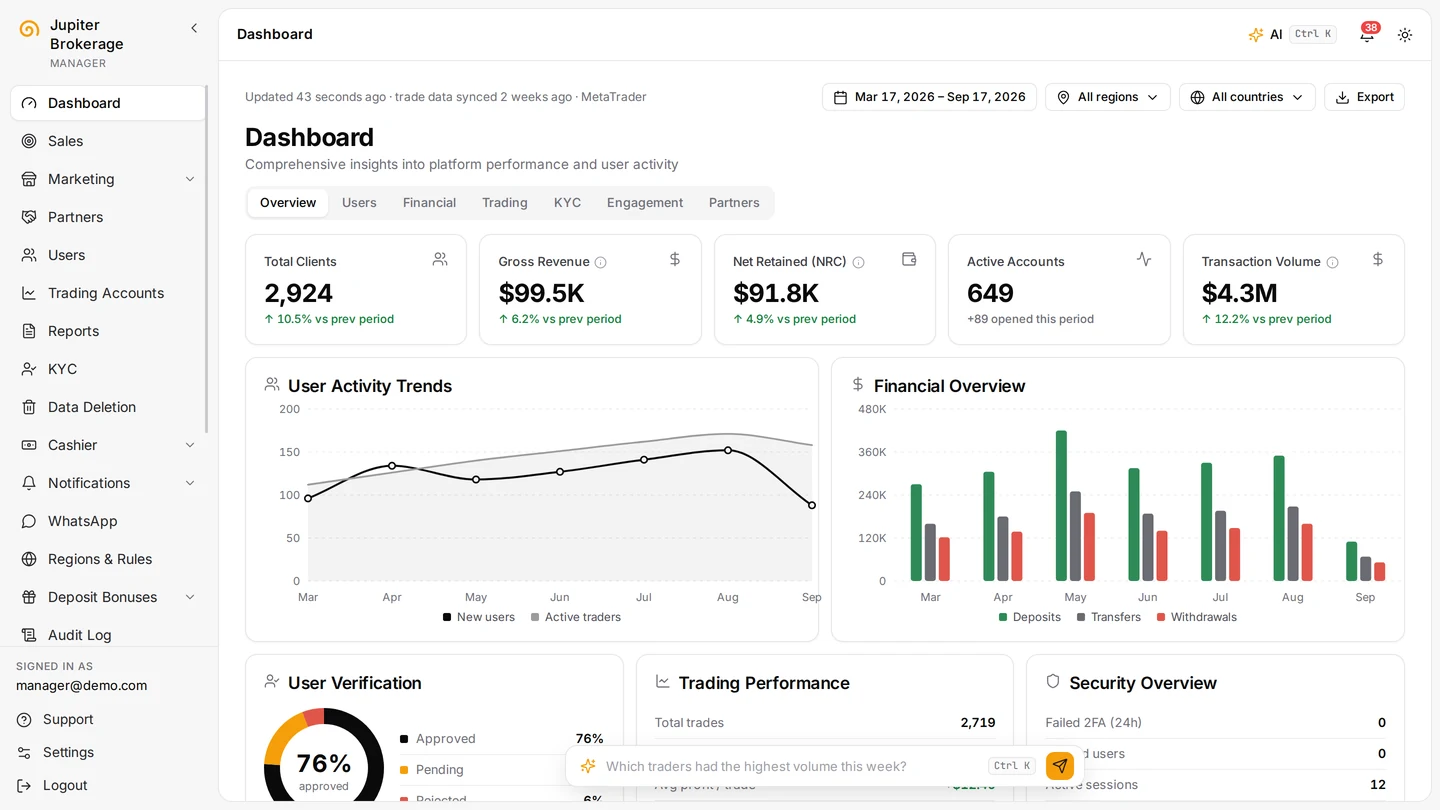
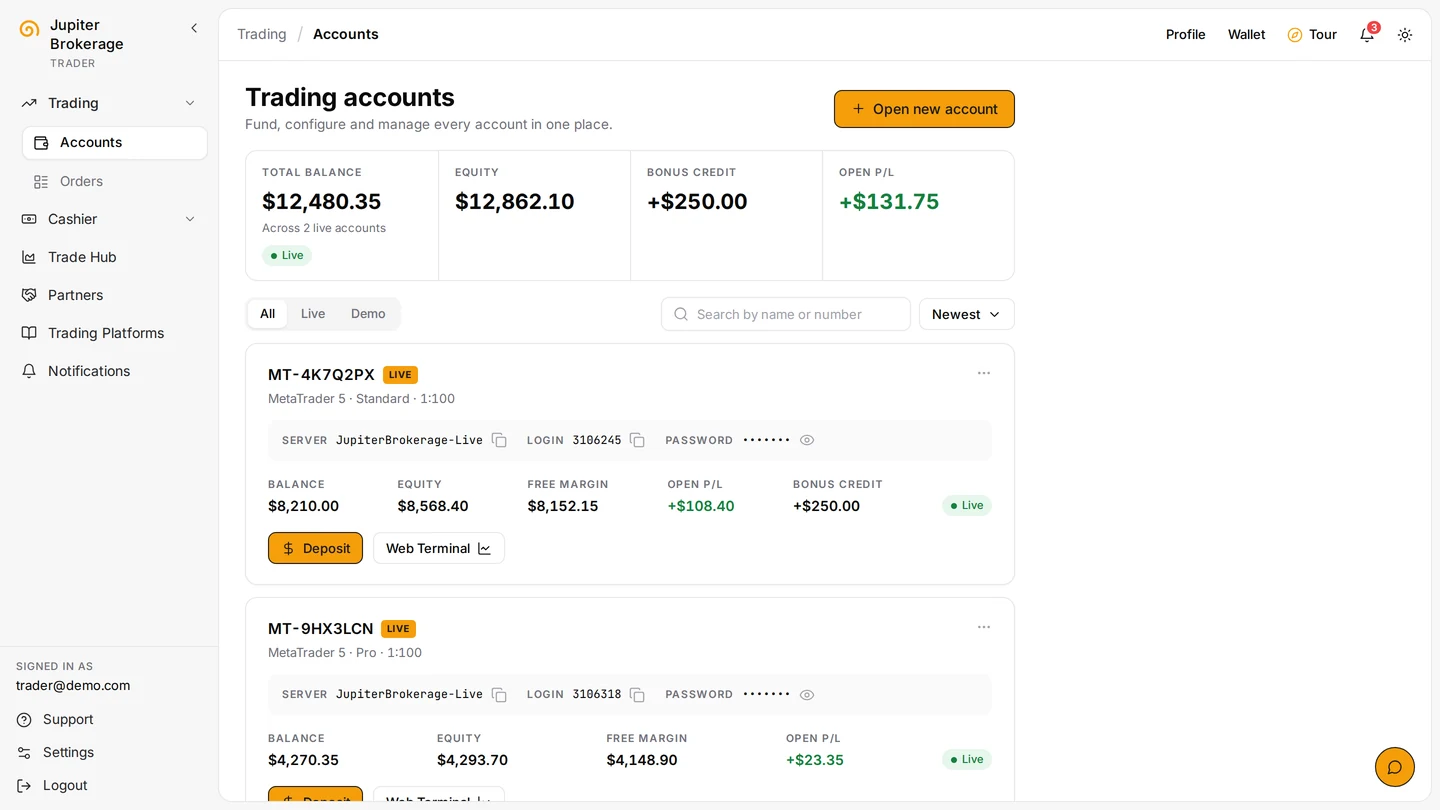
Manager dashboard, sample data. Tap to open. Ask the data from any screen: “Which campaign produced the most funded traders this month?”
Partners and integrations









Two rooms. One record.
Callisto is two products that share one trader record. The back office is where owners, managers, sales, compliance and finance work. The trader room is the client and IB portal. Nothing is copied between them, so the desk, the partner and the dashboard never disagree about the same person.
Run acquisition, sales, partners, compliance and finance from one place, with the AI assistant one keystroke away on every screen.
A portal that gets a new client from signup to first trade in under five minutes, then gives them reasons to come back.
Also in the back office: Users, Trading accounts, Notifications, Data deletion and Audit log. Also in the trader room: Cashier, Trading platforms and Notifications. Every screen is the real product with sample data; people and figures are fictional. Open any screen to view it at full size.
Table stakes, then the difference
A brokerage CRM stores contacts and moves tickets. Callisto does that too, but it is organised around commercial outcomes: where a trader came from, what they became worth, and which decision that should change.
Everything a CRM does is here: client portal and onboarding, KYC and compliance, cashier, ledger and withdrawals, the IB programme and the sales desk. With more under the hood: commission, spread or hybrid partner economics across multiple levels, and a desk that sees source, campaign and KYC before the first call. Then the part a CRM can’t do:
| Capability | A traditional brokerage CRM | Callisto |
|---|---|---|
| Client portal and onboarding | Yes | Signup, KYC, first deposit and first trade in under five minutes, with the checklist visible throughout. |
| KYC and compliance | Yes | Provider verification, manual override, regions mapped to rule sets, audit log and data deletion. |
| Cashier, ledger and withdrawals | Yes | Multiple payment providers, a ledger that reconciles, a withdrawal queue with KYC and risk flags. |
| IB programme | Yes, usually one rev-share model | Commission, spread or hybrid economics by symbol and account type. Multi-level networks. A tracking link per campaign for every partner. |
| Sales desk | Yes, a contact record | Source, campaign, geo, KYC and deposit context before the rep engages. Today view, queue and funnel by stage. |
| Attribution to trader value | Stops at registration | Source, signup, KYC, FTD, first trade, activity and value on one record, rolled up to campaign, channel, geo, publisher and IB. |
| Signals back to Meta and Google | Pixel events only | Configured downstream outcomes such as KYC, FTD and trading activity returned as optimisation inputs. |
| Promotions | Redemption counts | Deposit bonuses configured on the same record as funding and trading, so offers can be read alongside the traders they produced. |
| Client communication | Two-way WhatsApp and event automations. 98% open rate against 20% for email. | |
| Reporting | Exports and dashboards | Dashboards with plain-English insights, and conversational analytics across the connected data. |
| Implementation | Months | 14 days. Scope, launch criteria and acceptance testing agreed before production. |
Six revenue engines. One commercial truth.
These are not six products. Each engine reads from, and writes back to, the same connected record. That is why a campaign report, an IB review and a sales call can finally agree.
Every trader carries source, campaign, geo and acquisition cost in, and value back out. Compare campaigns, channels, geos, publishers and IBs by the traders they produced, not the registrations they counted.
Configured downstream outcomes, such as KYC, FTD and trading activity, can be returned to the ad platforms so they optimise towards traders who fund, not clicks that register. Better inputs, not autonomous budgets.
Commission, spread or hybrid economics by symbol and account type. Multi-level structures with allocation across tiers. A link per campaign, so each partner sees which of their own campaigns funds traders.
Signup, KYC, first deposit and first trade in under five minutes. The sales desk sees source, campaign, geo and KYC status before the first call, and the funnel is measured stage by stage.
Deposit bonuses configured by region, account class and date range on the same record as funding and trading, so promotional activity can be read alongside funded traders and downstream value.
Economic calendar, calculators and market tools in the portal give traders reasons to return. WhatsApp reaches them for account and status updates in a channel with a 98% open rate, against 20% for email.
AI-native
Conversational analytics sits on the connected record, so a CEO or commercial lead can ask across partners, campaigns, KYC, transactions and trading without waiting for another report. Every dashboard also carries Insights: a plain-English read of what moved, and which way.
Direct interrogation of connected data. Not autonomous decision-making. Answers below are illustrative and use the same sample data as the screens.
Trader room · onboarding
Onboarding is conversion infrastructure, not administration. Every step the trader takes is visible on the checklist, funding is guided rather than forced, and the desk can see exactly where a prospect stopped.
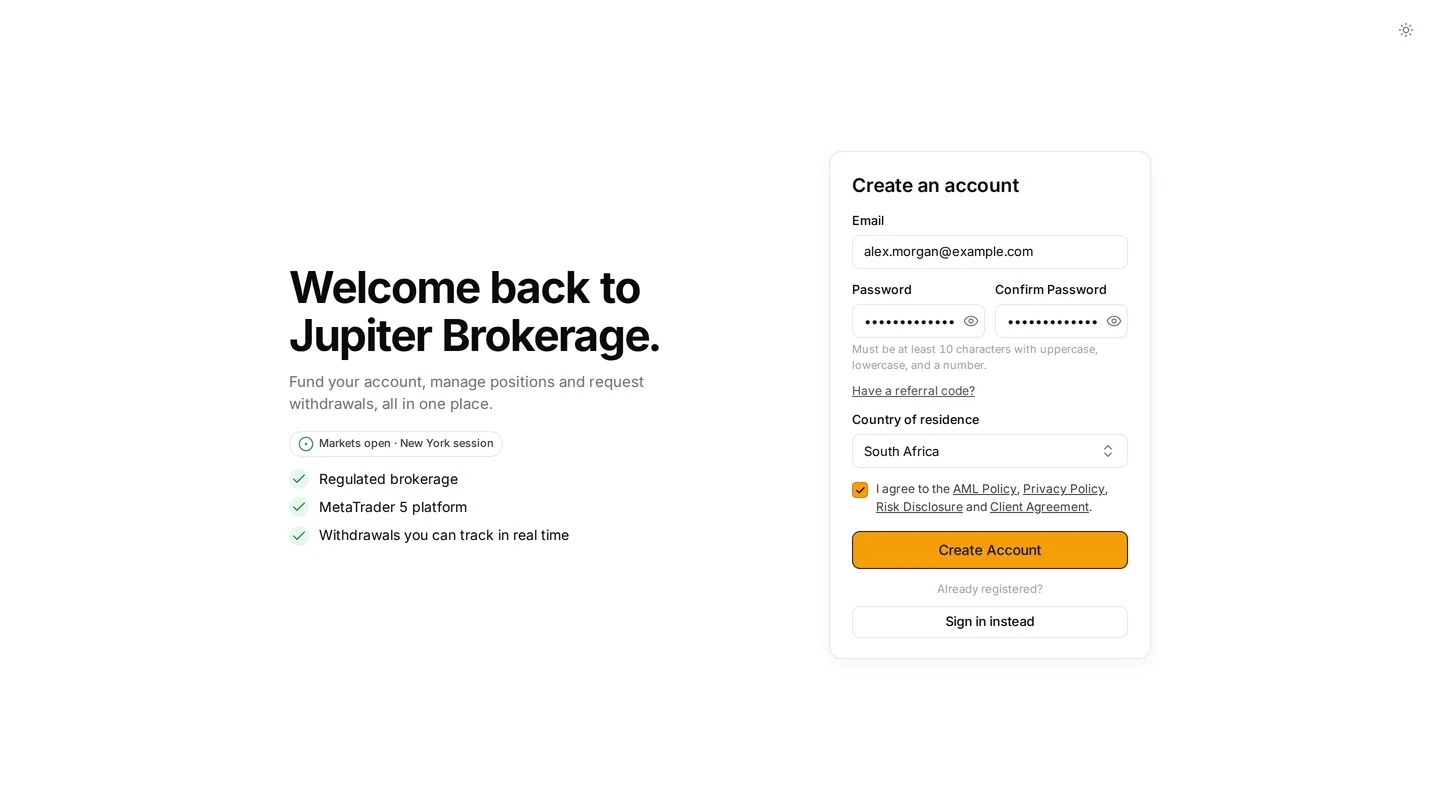
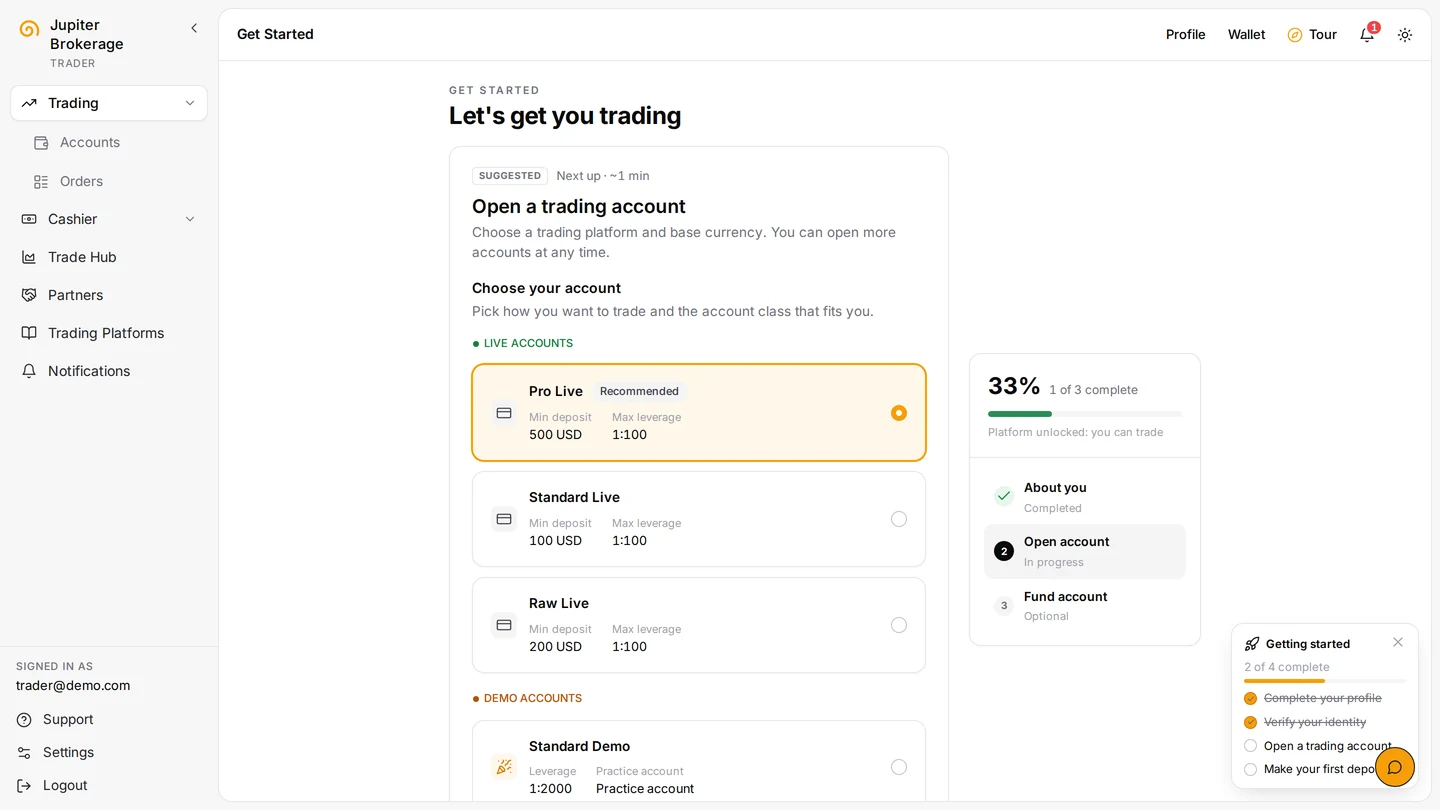
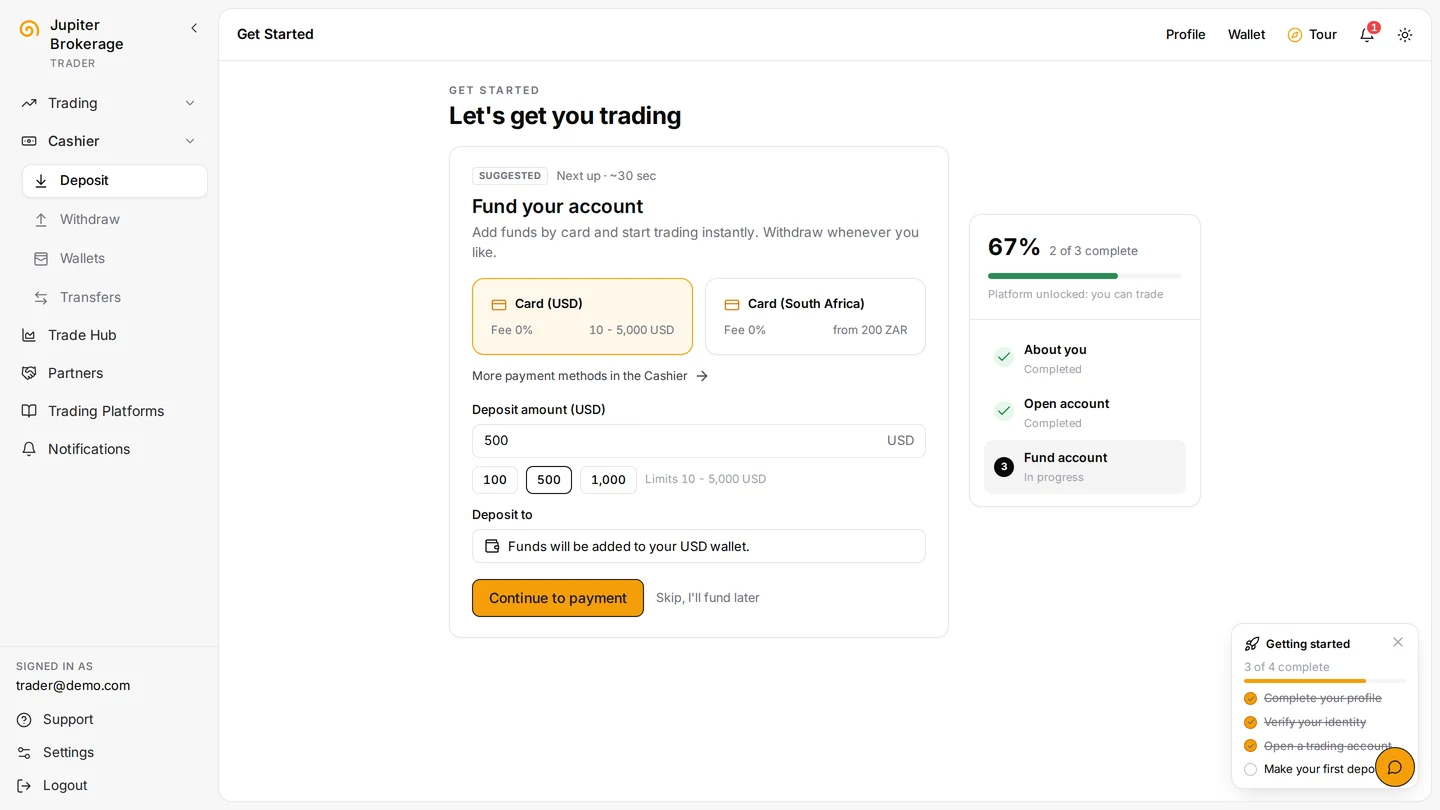
After the first trade the portal keeps working: an economic calendar before every major event, position and margin calculators, market news, and a partner portal for clients who refer others.
Relevant account and status updates go out on WhatsApp through approved templates mapped to platform events. Conversations come back into a shared inbox in the back office.
The wider operating layer
Revenue intelligence only becomes operating leverage when compliance, finance and the trading platform run from the same system. They do.
KYC review with provider verification, regions mapped to rule sets for leverage and account classes, audit log, GDPR data deletion.
A transaction ledger that reconciles, a withdrawal queue with KYC and risk flags, and payment providers managed from the back office.
MetaTrader 5, cTrader and TradeLocker; Sumsub for verification; Praxis and other cashiers; Meta and Google; bespoke brokerage systems where required.
Money-manager and pooled-capital account structures alongside the wider operating system, for brokers who run managed accounts next to retail.
Ask us about it on the demo.
Implementation
Legacy brokerage software moves at the speed of its vendor. Callisto is implemented against a written scope with launch criteria and acceptance testing agreed before anything reaches production.
Platforms, providers, regions, partner models and migration agreed and written down, with what “live” means.
Trading platform, KYC, cashier and ad accounts connected. Rule sets, tiers, bonuses and templates configured with your team.
Acceptance testing against the criteria, data checks, training for the desk and the back office. Then production.
Book a demo
Thirty minutes. Both rooms, live, with sample data. Bring the questions your current stack can’t answer and we will show you where the answer sits.